
Leak Detection.
Ultra-precise helium testing designed to detect the smallest vacuum leaks in critical components. Prevent system downtime and guarantee airtight seals with our advanced diagnostic technology.
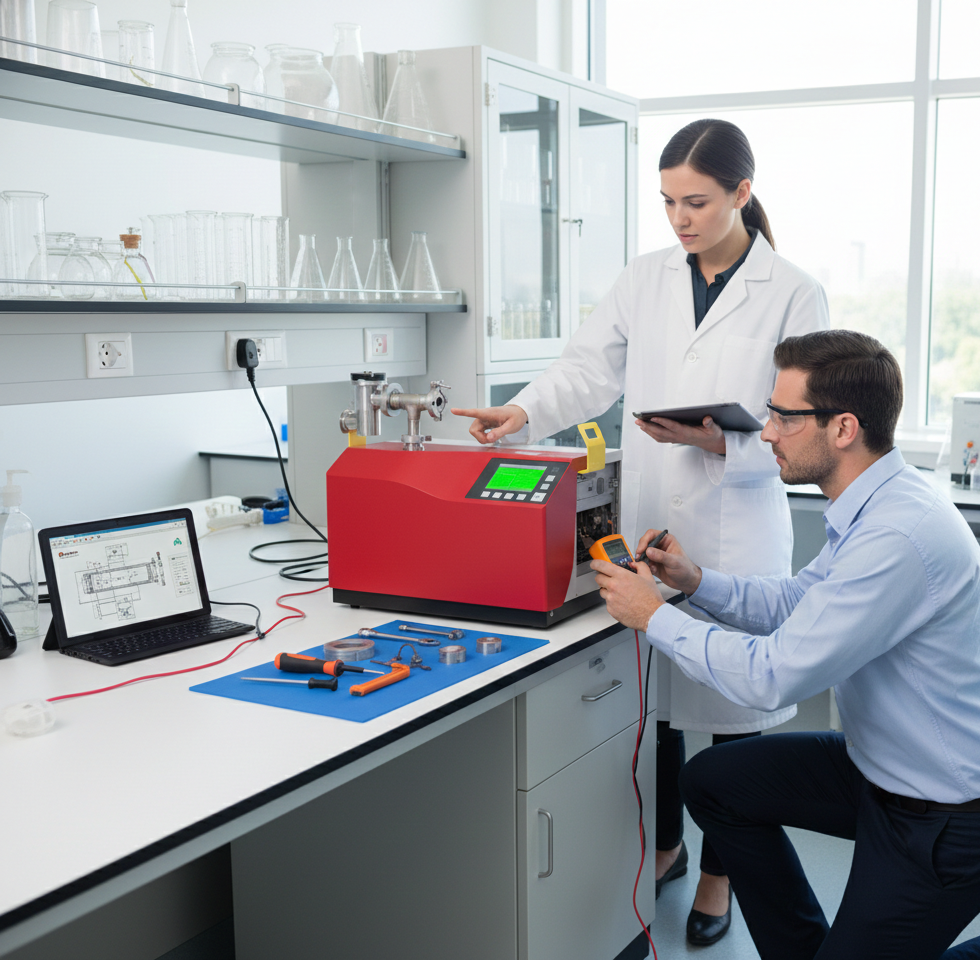
Leak Detection: The Backbone of Critical Industrial Processes
In the world of vacuum engineering, even a microscopic leak can compromise an entire process. Leak testing is not just a maintenance step; it is a critical quality control measure used to verify the integrity of manufacturing equipment and the final manufactured product.
At Dinesh High Vacuum Engineering, we understand that different industries require different levels of sensitivity. Whether you are manufacturing automotive parts, ensuring the seal on medical packaging, or validating a PVD coating chamber, our solutions provide the accuracy you need.
Why We Use Helium
(The Science)
The Gold Standard in Tracer Gas We utilize Helium as our primary tracer gas for one simple reason: it offers the most reliable results.
Deep Penetration: Because Helium has an incredibly small atomic size, it can pass through the tiniest imperfections that other gases would miss.
Safe & Inert: It is non-toxic, non-flammable, and chemically inert, making it safe for both the operator and the component being tested.
Distinguishable: Since Helium is present in the atmosphere at only 5 ppm, our mass spectrometers can easily detect a leak against the background air with zero false positives.
Global Availability: It is cost-effective and easy to source, ensuring your testing process remains economical.
HELIUM LEAK DETECTION
Vacuum Integrity Analysis
We provide industrial-grade leak testing for vacuum chambers, pipelines, and sealed systems. Utilizing mass spectrometry for absolute precision.
- ➔ PVD Coating Systems
- ➔ Vacuum Furnaces
- ➔ Cryogenic Piping
- ➔ UHV Chambers
Specialized Support for R&D
Precision for Research Institutes Research laboratories demand the highest sensitivity. We partner with institutes to create tailor-made testing benches that allow for the precise characterization of experimental setups. Whether working with ultra-high vacuum (UHV) or requiring specific clean-room standards, our engineering team delivers the performance required for scientific breakthrough.